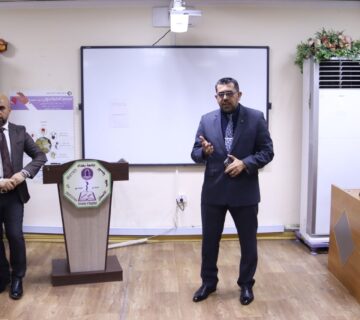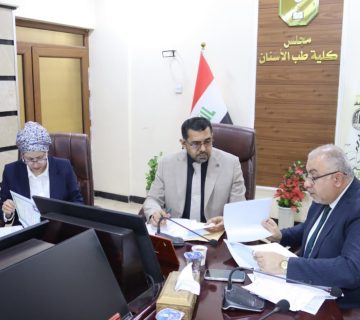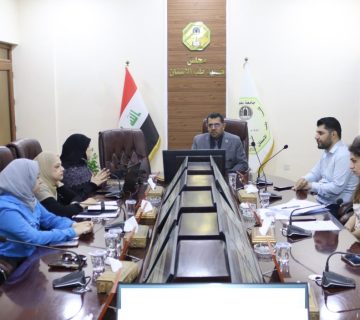
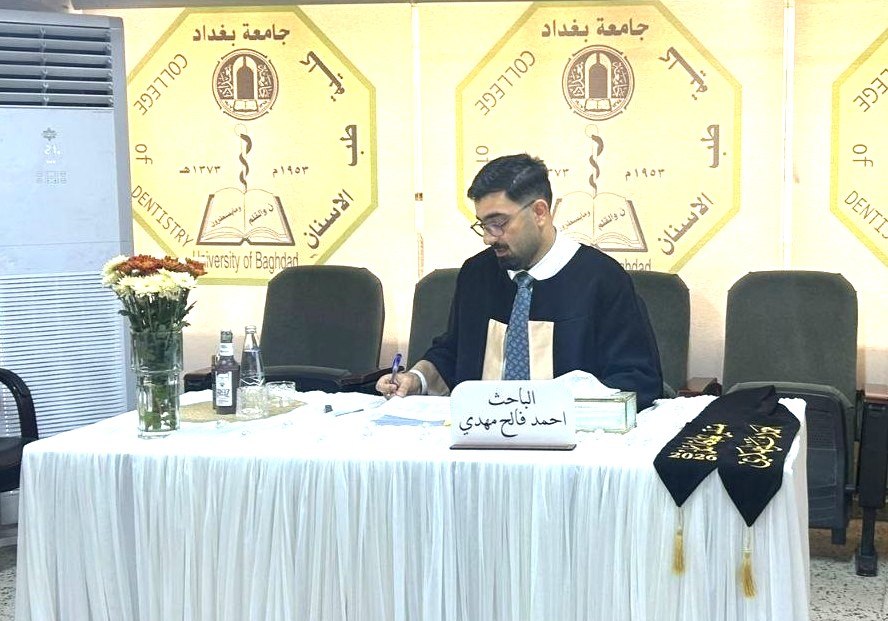
The College of Dentistry at the University of Baghdad discussed a Master’s thesis entitled “Adopting a Biological Approach for the Treatment of Deep Dentin Caries Lesions Using Dentin Matrix Protein-1 (DMP-1): An In Vitro Comparative Study” submitted by the student Ahmed Faleh Mahdi.
The thesis aimed to evaluate the therapeutic effect of Dentin Matrix Protein-1 (DMP-1) in the management of caries-affected dentin (CAD) lesions and to compare its efficacy with Mineral Trioxide Aggregate (MTA) and Sylc® bioactive glass. The investigation included assessments of the chemical, mechanical, and morphological properties of treated dentin lesions using micro-Raman spectroscopy, Vickers microhardness testing, and scanning electron microscopy (SEM) before and after treatment.
The study involved the preparation of thirty carious dentin discs, which were examined visually and using a Diagnodent Pen, yielding readings ranging from 0 to 20. The specimens were then allocated into three treatment groups: DMP-1, MTA, and Sylc bioactive glass (BAG) applied through AquaCare air-abrasion technology.
Following treatment, Fourier Transform Infrared Spectroscopy (FTIR) and contact angle measurements were performed for DMP-1. In addition, micro-Raman spectroscopic analysis was conducted to evaluate the mineral and organic content of the treated dentin, while tissue hardness was assessed using a Vickers microhardness tester.
The study concluded that Dentin Matrix Protein-1 (DMP-1) represents an effective biological alternative capable of enhancing both the mineral and organic phases of demineralized dentin surfaces. Furthermore, both MTA and Sylc/BAG air-abrasion treatment were found to be effective approaches for the management of deep dentin caries lesions. These findings support the potential clinical application of biologically based treatment strategies aimed at preserving the structural and functional integrity of caries-affected dentin.
The thesis was accepted by the examination committee.